

Each lipid molecule is covalently linked to a Nanogold® or undecagold cluster through its polar head group. Since the gold moiety is hydrophilic, these molecules retain the amphiphilic nature of the parent lipid, and behave like fatty acids or phospholipids.
Study membranes by incorporation into the lipid phase, or gold-label micelles and vesicles so that they can be identified and visualized.
- Discrete, single molecules: one lipid to one gold cluster label
- Covalent attachment ensures consistent structure and properties
- Stable, long shelf life
- Soluble in organic solvents and alcohols for easy incorporation into liposomes
- Visualize directly by EM
- Easy enhancement to see by eye or LM
- Available with 1.4 nm or 0.8 nm Nanogold®

Nanogold®-Lipid Conjugates: Each lipid molecule is covalently linked to a 0.8 nm or 1.4 nm Nanogold® cluster through its polar head group. Since the gold moiety is hydrophilic, these molecules retain the amphiphilic nature of the parent lipid, and behave like fatty acids or phospholipids.
-
Prepare novel arrays and nanostructures using the phase properties of labeled liposomes
- Use silver enhancement or gold enhancement for a highly visible, permanent signal in lipoimmunoassays
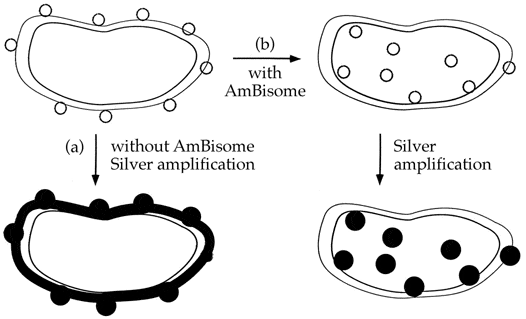
Schematic showing the pathways of Nanogold®-labeled liposomes in cells, as revealed by EM. Ambisome is a channel-forming anti-fungal drug: in its absence, the pattern of the label as revealed by silver enhancement shows that the liposome fuses with the cell membrane (left), but when it is present, the liposomes enter the cell (right) and Nanogold® accumulates in the cytoplasm (Adler-Moore, J.; Bone Marrow Transplantation, 14, S3-S7 (1994)).