1.4 nm Non-fuctionalized Nanogold® is an inert, stable form of the 1.4 nm Nanogold® particle with no reactive chemical functionalities or specific affinity properties.
Applications:
- As a size standard for calibration in high-resolution electron microscopy.
- Sizing pores (see: Schwartz, M. P., and Matouschek, A.: The dimensions of the protein import channels in the outer and inner mitochondrial membranes. Proc. Natl. Acad. Sci. USA, 96, 13086-13090 (1999)). [Complete references]
- For tracing contiguous interior spaces in cells and tissues.
1.4 nm Nanogold® Labeling Reagents
Nanogold® is a better gold label.
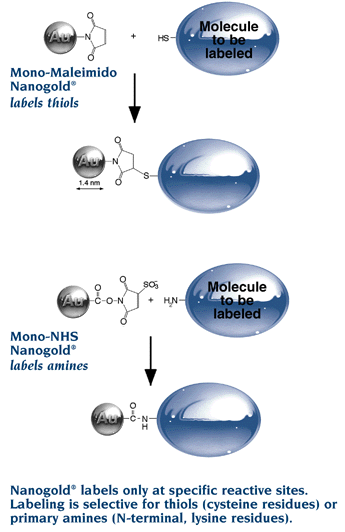
The 1.4 nm Nanogold® particle is a gold compound: it is not just adsorbed to proteins, like colloidal gold, but covalently reacts at specific sites under mild buffer conditions. This gives a well defined product that can be purified chromatographically.
Nanogold® brings the versatility of fluorescent conjugation to gold labeling.
Label virtually any molecule
Label any molecule with a suitable reactive group: oligonucleotides, lipids, peptides, proteins, enzyme inhibitors and others. This is a big improvement over colloidal gold, which may be adsorbed only to antibodies and a limited range of proteins and peptides.
Nanogold® is small and highly uniform in size, in sharp contrast to small colloidal gold preparations (most commonly used “1 nm” colloidal golds actually range from 1 to 3 nm).
Label your own biomolecules with our Nanogold® labeling reagents,
or check out our range of antibody IgG, Fab’ and streptavidin Conjugates with Nanogold®.

Left: Silver-enhanced Nanogold®-labeled K+ channel Kv2.1 subunit in rat brain, X15,000 (J.-H. Tao-Cheng, NIH).
Right: Darkfield STEM micrographs of Maleimido Nanogold® labeled A β peptide targeting proteasomes; sample was stained with methylamine vanadate. White dots are 1.4 nm Nanogold®.From Gregori, L., Hainfeld, J.F., Simon, M.N., and Goldgaber, D. (1997). Binding of amyloid beta protein to the 20S proteasome. J. Biol. Chem. 272, 58-62.
Easily enhanced for electron microscopy, light microscopy, cryo-EM, blots…
Try our precision nanoparticle developers for slow development with low background!
Features and Advantages
- Unparalleled penetration of conjugates -up to 40 µm!
- Higher density of immunolabeling than with larger gold probes.
- Can be conjugated to any molecule with a suitable reactive group. Available with different reactivities.
- Extremely uniform 1.4 nm gold particle.
- Label at specific sites which do not obstruct native reactivity.
- Close to stoichiometric labeling.
- Reacts under mild, neutral conditions.
- Conjugates are easily isolated by gel filtration.
- Conjugates are stable to a wide range of pH and ionic strengths.
- High stability: conjugates show unchanged reactivity after storage for a year.