

Simple to use-- incredible results. Precise, permanent labeling with Nanogold®
5 nm Monomaleimido Nanogold® is a highly monodisperse, highly water-soluble, stable, and biocompatible 5 nm gold nanoparticle, with a hydrophilic coating, modified with maleimide groups that react with thiols (sulfhydryls) under mild conditions (pH 6.0 to 7.0).
Selectively label any molecule with an accessible thiol group!
- Antibody IgG and IgM: label at a hinge thiol, remote from the binding site – preserve affinity.
Antibody Fab’ fragments: attach the 5 nm Nanogold® at the hinge thiol at the opposite end to the binding site – preserve maximum native affinity. - Proteins and peptides: Label selectively at a unique thiol site, or incorporate a Cys residue during peptide synthesis at the site you wish to localize.
- DNA, RNA and PNA: Use a thiol-modified phosphoramidite or cysteine during synthesis to put a thiol right where you want the gold – or modify enzymatically in situ to place the gold at the modification site.
- Nanostructured materials: label a building block, then assemble for a programmed gold nanoparticle array, or program specific labeling sites into a nanostructure and add the gold afterwards.
Small molecules: Decorate 5 nm Nanogold® with small molecules such as hormones, inhibitors, or signalling molecules, then localize binding sites with molecular precision.*- * 5 nm Maleimido Nanogold® is polyfunctional, so labeling reactions need to be planned to avoid cross-linking and control the ratio of Nanogold® to conjugate biomolecule. See the product information and instructions for more information and suggestions.
Schematic showing reaction of 5 nm Maleimido Nanogold® with a thiol-functionalized molecule.
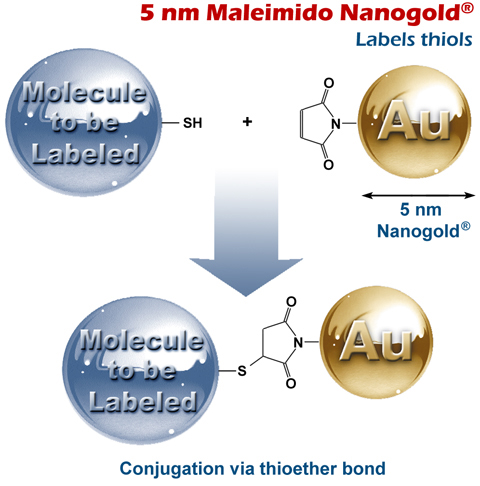
Use our unique Nanogold® labeling reagents just as you would use fluorescent labeling reagents.
Labeling with 5 nm Monomaleimido Nanogold®, like the smaller 1.4 nm Monomaleimido Nanogold®, is straightforward: Simply mix reconstituted 5 nm Monomaleimido Nanogold® with the target molecule for one hour at room temperature or 16 h in the refrigerator.
Once reaction is complete, conjugates may be chromatographically separated by gel filtration. Alternatively, labeled proteins may be isolated by ammonium sulfate precipitation, and oligonucleotides by ethanol precipitation or gel electrophoresis. Ion exchange chromatography or hydrophobic interaction chromatography may also be useful.
The maleimide group specifically reacts with a thiol under mild conditions to produce a stable, covalent thioether bond.
5 nm Nanogold® Labeling Reagents
The precision and versatility of Nanogold®, now in a larger 5 nm size
Like our smaller 1.4 nm Nanogold® reagents, it covalently reacts at specific sites under mild buffer conditions. This gives a well defined product that can be purified chromatographically or by ammonium sulfate precipitation.
Unlike conventional colloidal gold, 5 nm Nanogold® does not require any additional macromolecules for stabilization. Conjugate probes are smaller than colloidal gold probes and achieve higher resolution, more precise and more nearly quantitative labeling.
Make any molecule a gold probe
Nanogold® brings the versatility of fluorescent conjugation to gold labeling. Now you have a choice of sizes for Nanogold®: 0.8, 1.4, 5 or 12 nm, enabling multiple labeling for electron microscopy without silver or gold enhancement!
- Antibodies
- Proteins
- Peptides
- Oligonucleotides and nucleosides: DNA, RNA and PNA
- Nanostructured materials
- Hormones
- Polymers
- Surfaces
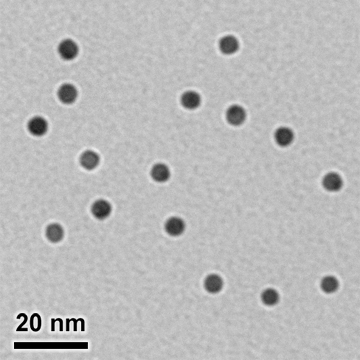
Unconjugated 5 nm Nanogold®, showing monodisperse, highly regular, spherically symmetrical 5 nm gold core and uniform, thin and consistent ligand coating. This ensures a highly regular particle size, smaller probe size, and reliable, reproducible labeling and EM results.
Easily enhanced for electron microscopy, light microscopy, cryo-EM, blots…
Try our precision nanoparticle developers for easily controlled development with low background!
Features and Advantages
- Stable, soluble and biocompatible: Designer coating gives solubility and biocompatibility for in vivo use. No residual charge means minimal non-specific binding.
- Highly monodisperse. Size variation less than 15% for 5 nm gold. 1.4, 5 and 12 nm Nanogold® enable up to triple labeling with non-overlapping sizes
- Molecular precision: make smaller primary probes that get the gold closer to the target.
- Site-specific conjugation enables programmed incorporation into nanostructured materials or components of self-assembling systems.
- No need for additional proteins or polymers: smaller probes penetrate better and label more densely.
- Easily enhanced. Silver or gold enhancement enlarges while retaining monodispersity – or affords super-sensitive detection for blots and optical systems.
- Pick the optimum size: smaller for high resolution, molecular labeling, larger for visualization on a cellular scale.
Although larger than our 1.4 nm Nanogold®, our new 5 nm Nanogold® is still relatively small in size, and highly uniform. Because it does not require additional proteins for stabilization, 5 nm Nanogold® conjugates are smaller than most conjugates prepared with conventional colloidal gold and uniform in overall size, giving them faster and more consistent penetration into specimens.
If larger particle sizes are needed, 5 nm Nanogold® may easily be enhanced with GoldEnhance™ gold enhancement reagents, or our HQ Silver™ or LI Silver™ silver enhancement reagents: Depending on the reagents used, a brief exposure (1 – 4 minutes) produce highly visible grains 10-20 nm in size for electron microscope identification, while longer development times produce black signals, readily differentiated from organic chromogens, that are easily seen in the light microscope and on immunoblots, gels and Western blots.